Counter Sink Bits
Compared on price, power and value, with prices checked daily against Amazon UK. Not sure where to start? Our buying advice is further down the page.
-
Trend Snappy 12.7mm Tool Steel Countersink with Adjustable 3.5mm Drill, Perfect for Hard & Softwoods, SNAP/CS/12, 9/64in
Original price was: £9.97.£7.99Current price is: £7.99. -
Trend Snappy 5-Piece Countersink & Drill Set for No4-No12 Gauge Screws, Quick Release, Pilot Holes & Countersinks in One Go, SNAP/CS/SET
Original price was: £39.77.£34.99Current price is: £34.99. -

Trend Snappy 9.5mm Tungsten Carbide Countersink, Adjustable 3mm Pilot
£19.99 -
Trend Snappy TCT 10mm Countersink with Non-Marring Depth Stop & 4mm HSS Drill, 1/4 Inch Hex Shank, Quick Release System, SNAP/CSDS/4MMT, Silver
Original price was: £25.30.£19.99Current price is: £19.99. -
Trend Snappy TCT 9.5mm Countersink with Adjustable 3.25mm Pilot Drill, Tungsten Carbide Tipped, Ideal for Ply, MDF & Chipboard, SNAP/CS/10TC
£19.54 -
Trend TCT Universal Countersink, 3.0mm – 7.2mm Diameter, Adjustable Counter Sink for Clamping Onto Any Drill Bit, UNI/CS
£32.95 -
UKDeals Direct® Universal Counter sink 3.0mm – 7.2mm Diameter Adjustable Countersink for Wood and Hard board
£15.99 -
uxcell a15110300ux0279 32mm Cutting Dia 60 Degree Chamfer Mill Cutter Countersink Drill Bit, Silver Tone
£23.69 -
Wincal 6Pcs Countersink Drill Bits Set, HSS 90 Degree Counter Sinker Drill Bits Set, Metal Woodworking Chamfering Cutter, HSS Titanium Coated Chamfer Drill Bit 6.3-20.5mm (Blue Iron Box)
£14.89 -
wolfcraft 3-Piece Conical Countersink Set, Ø 12-19 mm, Hexagon Shank
Original price was: £5.00.£3.63Current price is: £3.63. -
wolfcraft 3-Piece Deburring Counter Set, 8-16 mm, Hex Shank for Wood
Original price was: £20.17.£18.40Current price is: £18.40. -
wolfcraft Screw Starter with Countersink and Depth Stop for Wood, Ø 4-5 mm
£10.62 -
wolfcraft Tool Steel Countersink, Hexagon Shank I 2547000
Original price was: £2.84.£1.76Current price is: £1.76. -
YXIING 6 Pcs Countersink Drill Bit, Countersink Drill Bits Set1/4 Inch 12mm/16mm/19mm Counter Sink Drill Bits for Wood
£6.39


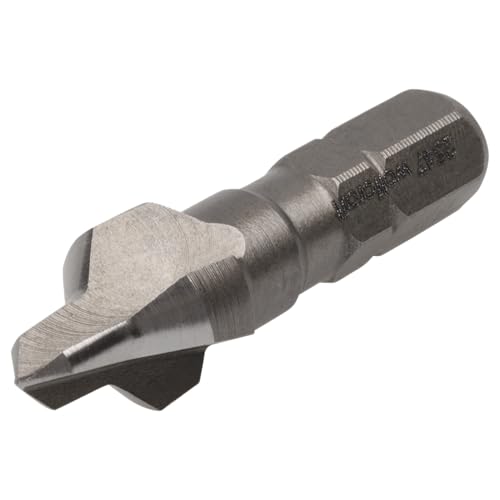

Choosing the right countersink drill bits
A countersink bit cuts a cone-shaped recess at the top of a hole so a countersunk screw head sits flush with, or just below, the surface. It is a small job that makes a big difference to how finished a piece of joinery, a kitchen fit or a set of shelves looks. Get it right and screws disappear neatly. Get it wrong and you end up with proud heads, split timber or chewed edges. Here is what to look for when you are choosing countersink drill bits for wood, plastic and metal. For a wider look at bits, see our guide to choosing drill bits for every material.
Types of countersink bit
The simplest type is a plain countersink with a cutting cone on a shank. You drill a pilot hole first and then use the countersink to chamfer the top. Combination bits put a tapered or straight drill and a countersink on one tool, so you drill the pilot hole and countersink in a single pass, which is a real time saver when you are fixing lots of screws. Many of these have an adjustable collar so you can set the drill length to suit the screw. Counterbore bits go one step further and cut a flat-bottomed recess so the screw head sits well below the surface, ready for a wooden plug. Plug cutters are often sold alongside them for this reason.
Angles and screw types
Most metric countersunk wood screws in the UK have a 90 degree head, so a 90 degree countersink is the usual choice. Imperial and some American screws use 82 degrees, and 100 or 120 degree countersinks turn up in sheet metal and aerospace work. Using the wrong angle means the head only touches the recess on one edge, which can crack the wood or leave the screw sitting proud. Check the screw packaging if you are not sure.
Flutes, materials and shanks
Single flute countersinks cut smoothly with little chatter and are good for deburring metal. Three and five flute designs cut faster and are popular for wood and plastic, though cheaper multi-flute bits can chatter and leave a rippled finish. HSS bits suit timber, plastics and soft metals such as aluminium and brass, while cobalt or carbide tipped bits last longer in steel and abrasive boards such as MDF. A 1/4 inch hex shank lets you drop the bit straight into an impact driver or quick-change chuck, and round shanks grip well in a three-jaw chuck.
Depth stops and getting a clean finish
A depth stop, often with a ball bearing so it does not mark the surface, lets you cut the same depth on every hole. That is ideal for hinges, cabinet hardware and decking, where consistency matters. Run the bit at a moderate speed, keep it square to the work and ease off as the cone reaches the right depth. Test on an offcut first, setting the depth so the screw head sits just below flush. In hardwoods, drilling a proper pilot hole first reduces the risk of splitting. If you are using an impact driver, our impact driver vs drill guide explains when a drill gives you better control.
Countersink drill bits FAQs
Do I need to countersink every screw? Not always. Many modern wood screws have nibs under the head that cut their own recess in softwood. In hardwood, MDF, laminates and near the edge of a board, a proper countersink gives a neater result and reduces splitting.
Can I countersink metal with a wood bit? Light deburring of aluminium is fine, but for steel use an HSS or cobalt countersink designed for metal, at a low speed with a drop of cutting oil.
Countersink or counterbore? Countersink when the head should sit flush. Counterbore when you want to hide the screw under a plug or fit a bolt head below the surface. Browse related bits in our power tool accessories, including drill bit sets.