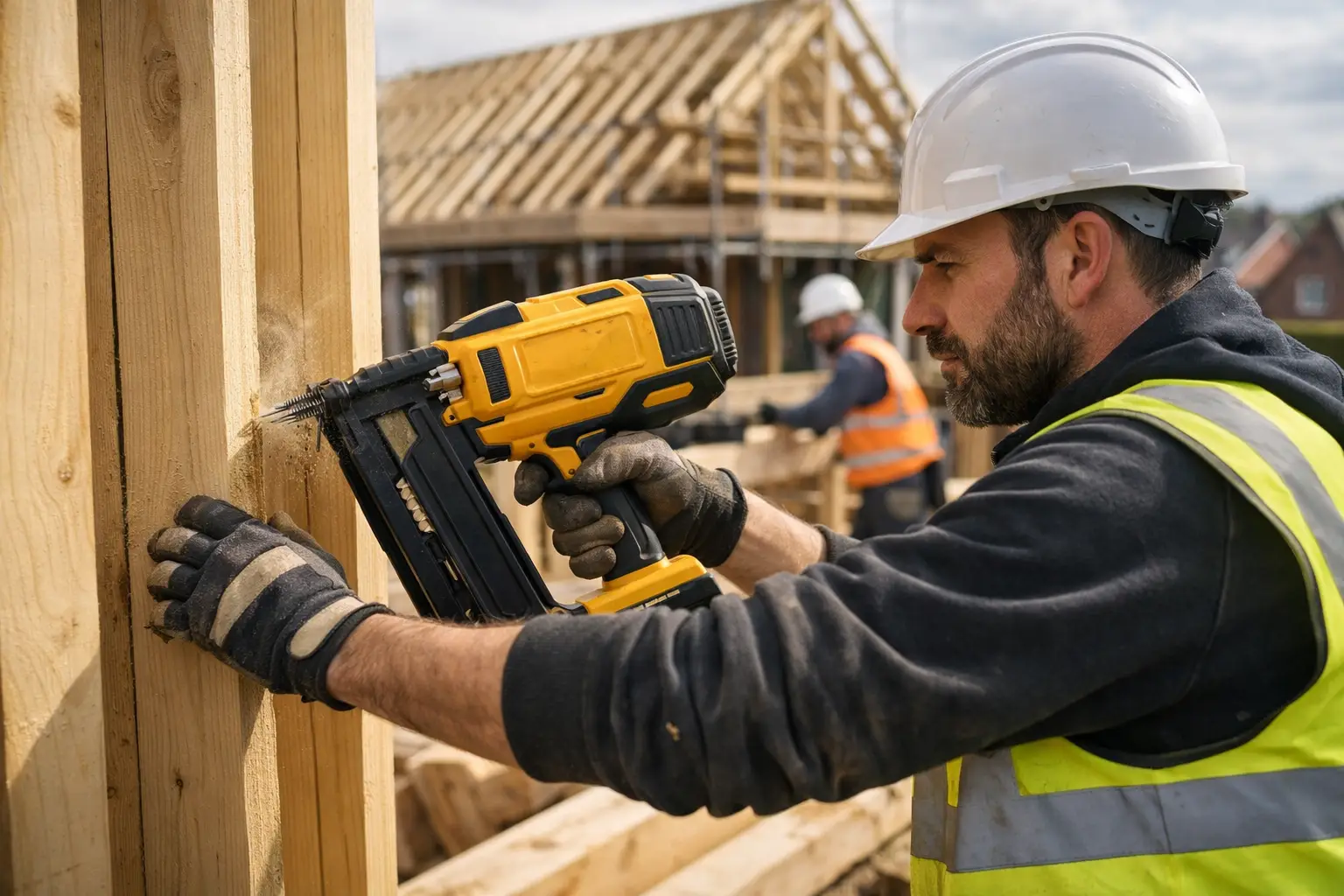
A DeWalt cordless nail gun can turn a slow, tiring job into a far more productive one. Whether you are fixing studwork, building a partition, constructing a roof or tackling a serious garden structure, the right DeWalt nail gun keeps things moving without the repeated swing of a hammer. The key is matching the tool, the 18V battery platform and the nail specification to the job in front of you.

DeWalt nail guns fall into two groups. First fix cordless nail guns, led by the framing nailer, drive large nails into structural wood. Second fix cordless nail guns, the brad and finish models, place smaller, neater fixings for trim and joinery. This guide covers both, starting with framing.
For trade users, that means dependable firing performance through a full day and a tool that earns its space in the van. For capable DIY users, it means buying a professional-quality tool that is manageable, safe and suitable for more than one major project.
What a DeWalt Nail Gun for Framing Is Built to Do
A framing nail gun is designed for structural fixing rather than lightweight finish work. It drives larger collated nails quickly and consistently into wood, making it suitable for first-fix applications where speed and holding strength matter. Common jobs include timber stud walls, joists, floor decking, fencing, sheds, workshops, cladding battens and roof construction.

This is not the same tool as a second-fix brad nailer or finish nailer. A brad nailer is ideal for trim, skirting, architrave and decorative work, but it does not have the nail length or driving force needed for framing. If the wood forms the structure of the project, a framing nailer is normally the right starting point.
Within the DeWalt range, the 18V XR brushless framing nailer, the DCN692, is the model to look at for this job. It is built for nails up to 90mm.
DeWalt cordless nail guns are particularly useful where running an airline across a site is inconvenient or impractical. There is no compressor to transport, no hose to manage and no gas cartridge to replace. That freedom is valuable when working in a loft, moving between rooms, fitting external timber or completing smaller jobs where compressor set-up would take longer than the fixing itself.
Cordless Framing Power: The Practical Benefits
DeWalt 18V XR brushless nail guns share the platform used across a wide range of DeWalt cordless power tools. For anyone already using XR drills, impact drivers or saws, a bare-unit nail gun can be a sensible, cost-effective choice. Shared Li-ion batteries and chargers reduce duplicate kit and keep things simpler on site.
The brushless motor has no carbon brushes to wear out and makes efficient use of each charge, which suits a tool that fires repeatedly through the day.

The main benefit is immediate readiness. Fit a charged pack, load the correct nails and you are ready to work. That is especially useful for punch-list framing, repair work, garden builds and first-fix tasks spread across several locations.
There are trade-offs. Pneumatic nail guns remain a strong choice for high-volume production work because they can be lighter in the hand and continue firing while an air supply is available. A cordless model carries the weight of its battery pack and internal drive system, so it can feel more substantial during overhead or repetitive use. For many users, however, the saved set-up time and freedom from hoses comfortably outweigh that extra weight.
Your choice of batteries matters too. A higher-capacity XR pack, such as a 5.0Ah, will usually run longer than a 2.0Ah, which helps when fixing several rooms of studwork or building a large structure. It also adds weight. A smaller 2.0Ah pack makes the nail gun easier to handle on short repair jobs, although keeping a spare charged pack nearby is the practical answer for uninterrupted use. Check whether a model is sold as a bare unit or in a kit with batteries and a charger, as the difference in cost can be significant.
Choose the Nail Specification Before You Buy
The nail gun must suit the nails required by your project. This is where buyers should slow down, as collated nails are not interchangeable simply because they are a similar length.
Check the compatible nail length range, shank diameter, collation angle and collation type for the exact DeWalt model you are considering. Many framing nail guns use paper-collated nails at a specified angle, but requirements vary between models. Loading the wrong nails can lead to poor feeding, jams, damage or nails that do not sit correctly.
Gauge matters most on the lighter tools. It describes the thickness of the nail, and a higher number means a thinner nail. An 18 gauge brad nail leaves a smaller hole than a 16 gauge finish nail but holds less. Match the gauge to the model’s rating rather than to whatever strip is left in the van.
Nail length should reflect the material thickness and fixing requirement. Shorter framing nails may be suitable for battens and lighter assemblies, while longer nails, up to 90mm on the largest DeWalt framing models, are needed for deeper structural connections. Galvanised nails are commonly chosen for outdoor wood and damp-prone environments, while ring-shank nails offer improved holding power where withdrawal resistance is important, such as roofing or decking. It is worth keeping a stock of the strips you use most so a job is not held up by a missing size.
For structural work, always follow the relevant building specification, fixing schedule and manufacturer guidance. A nail gun makes installation faster, but it does not replace correct timber sizing, suitable connectors or properly specified fixings.
Second Fix: DeWalt Brad and Finish Nail Guns
For trim and joinery, a second fix cordless nail gun is a different tool altogether. DeWalt’s brushless second fix range includes an 18 gauge brad nail gun, the DCN680, and a 16 gauge angled finish nail gun, the DCN660, both on the 18V XR platform.

A brad nail gun suits architrave, light mouldings, window boards and beading, where a small head and minimal hole matter. A finish nail gun has more holding power for skirting boards, door linings and stair parts. Both leave a hole small enough to fill and paint.
The advantages indoors are practical. There is no hose across a finished floor, no compressor noise in an occupied house and nothing to trail through freshly decorated rooms. For fitters moving between rooms or properties, a brushless second fix cordless nail gun is also quicker to set up than an air-powered alternative.
Many users end up with both a framing model and a brad or finish model, sharing the same XR batteries between them.
Features That Make a Difference on Site
A good nail gun should do more than fire a nail. The details affect how confidently and efficiently you can use it throughout a job.
Depth adjustment is one of the most useful features. It allows you to set the nail head flush with the surface or slightly recessed where appropriate, without reaching for a hammer to finish every fixing. Density changes between softwood, treated material and engineered timber, so check the depth setting on an offcut before starting the main job.
Sequential firing gives controlled, deliberate placement. You position the nose, depress it against the wood and pull the trigger for each nail. This is generally the better choice for accurate joints and for less experienced users. Bump or contact firing can speed up repetitive tasks, but it requires more control and should only be used where the task, working position and site rules allow it. Many DeWalt models let you switch between sequential and bump modes with a selector.
Look for a dry-fire lockout or low-nail protection where available. This helps prevent unnecessary marks and wear when the magazine runs low. Tool-free jam release is another worthwhile feature. Even quality collated nails can jam if the tool is angled badly, the material is particularly hard or incompatible nails have been loaded.
A rafter hook is also more useful than it sounds. On ladders, roof timbers or scaffolding, a secure place to hang the nail gun keeps it close without leaving it on a vulnerable edge or carrying it unnecessarily.
Is It Right for Your Type of Job?
For partition walls, a cordless DeWalt framing nail gun is a highly practical choice. It speeds up the repetitive fixing of studs, noggins and plates while keeping the area clear of hose runs. It is also well suited to loft conversions and renovation projects where access can be awkward.

For fencing, pergolas, sheds and garden rooms, cordless convenience is often the deciding factor. Outdoor projects frequently involve moving around the property, carrying materials and working away from a convenient power supply. A battery-powered nail gun lets you take the tool directly to the task.
For large-scale new-build framing, the answer depends on production volume. A cordless model is excellent for corrections, snagging, small runs and jobs where mobility is essential. A professional crew firing thousands of nails in a shift may still favour pneumatic equipment for continuous high-output use. There is no single best answer. Your options are cordless, pneumatic or a mix of both, and the right one depends on how often you fix, how long each task lasts and what equipment you already own.
For second fix, the choice is simpler. If you are fitting trim, skirting or door linings, a brad or finish model will do the job far better than a framing tool, however capable.
Safe, Accurate Use Starts With Set-Up
A nail gun deserves the same respect as any high-powered site tool. Read the instruction manual for the exact model, wear suitable eye protection and keep hands well clear of the fixing line. Never point the tool towards yourself or another person, even when it is unloaded.

Before starting, inspect the nail gun, magazine and contact tip, and check the pack is seated properly. Use straight, dry collated nails that match the stated specification. Damaged strips or nails stored in poor conditions can affect feeding. Test the firing depth on scrap wood, particularly when changing from one material to another.
Be aware of what is behind the surface. Nails can follow grain, deflect near knots and occasionally pass through thinner stock. This matters when fixing near cables, pipework, hidden services or the edge of a joist or rail. Keep the nose square to the surface where possible and avoid firing too close to edges, where splitting is more likely.
When the job is done, remove the battery before clearing a jam, adjusting the tool or carrying out maintenance. Keep the magazine clean, store the tool dry and inspect it regularly for worn contact parts or damage. A well-maintained nail gun is safer and more likely to deliver consistent results when the job is under pressure.
Buying With Confidence
The best DeWalt nail gun is the one that matches your expected nail sizes, workload and existing batteries. If you already run DeWalt XR tools, the platform compatibility alone can make a cordless nail gun a practical addition. If this is your first major cordless purchase, consider the batteries and charger as part of the complete cost rather than focusing only on the bare tool price.
As a rough guide, the DCN692 suits structural fixing up to 90mm, the DCN680 suits light trim and beading, and the DCN660 suits skirting and door linings. Compare the full DeWalt nail guns range against the jobs you actually do before choosing.
At UK Tool Store, professional trades and serious DIY users can choose recognised DeWalt equipment for projects that demand reliable fixing power. Check the specification carefully, select compatible nails, check current stock and make sure you have enough pack capacity for the scale of the job.
A nail gun should make the job faster, not encourage rushed fixing. Take a moment to test the depth, confirm the nail specification and set out the structure accurately, and you can tackle it with confidence.